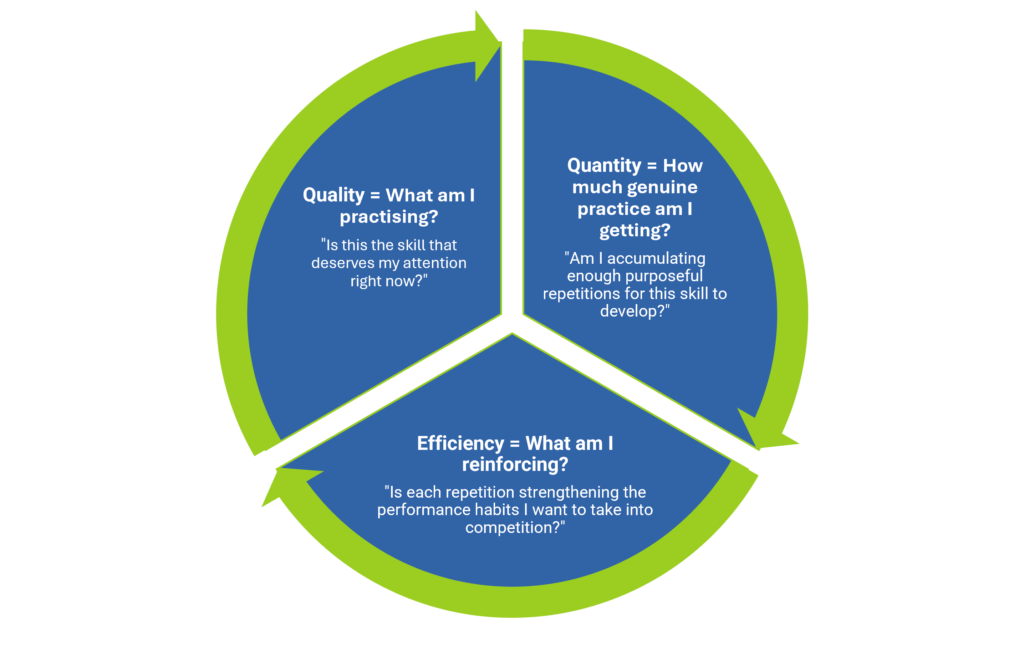
Quality, quantity, and efficiency – three elements that determine whether a shooting practice truly leads to improvement.
Other Pointers
Shooting Practice Beyond Quality and Quantity
Živa Dvoršak
Aug 6, 2026
When coaches and athletes discuss shooting practice, the conversation often turns to quality versus quantity. Which matters more? In reality, I believe we’re missing a third ingredient – one that often determines whether a training session turns into genuine improvement or simply into another day at the range.
Years ago, while reading With Winning in Mind by Lanny Bassham, I came across the idea that really resonated with me. His explanation is part of a broader mental management system, but the simple framework of quality, quantity, and efficiency has stayed with me ever since. Over the years, I’ve found it translates remarkably well to Olympic shooting, where success depends not only on how much we train, but on how effectively every repetition contributes to becoming a better shooter. With that in mind, let’s look at what each of these really means on the firing line.
Quality: Are You Practicing the Right Things?
Most shooters understand that quality matters. We all know that ten perfect repetitions are usually more valuable than fifty careless ones. But quality starts even earlier than the shot itself. It begins with choosing the right thing to practice.
A training session can be technically excellent and still produce little improvement if we are working on the wrong problem. Imagine a shooter who spends weeks trying to improve stability because they believe movement is costing them points. They perform beautiful holding drills, carefully repeat the exercises, and become very disciplined in their training. But what if the real limitation was not stability? What if the biggest issue was trigger control? Or timing? Or shot preparation? The training was executed well – but it didn’t solve the problem holding the shooter back. That is why quality requires us to ask
AM I PRACTICING THE THING THAT ACTUALLY LIMITS MY PERFORMANCE?
Poor quality training is not necessarily lazy training. Sometimes it is perfectly executed practice … of the wrong thing. On the other hand, high-quality training includes receiving good coaching and useful feedback, working on the correct technical elements, choosing an appropriate drill for the current goal, and understanding why a particular exercise is being performed.
Quantity: Training Time vs. Learning Time
Ask a shooter how training went, and often the first answer is a number.
“I shot 300 rounds today.”
“I spent three hours at the range.”
Quantity is often measured in rounds fired or hours spent at the range. Those numbers certainly matter – skills need repetition to develop. But simply being present at the range doesn’t guarantee enough useful practice. More is not automatically better. A shooter who spends half a training session chatting, checking scores, changing targets, adjusting equipment, or simply going through the motions may have spent a lot of time at the range – but accumulated very little learning.
Quantity means giving the skill enough repetitions to develop – shots where you’re engaged, focused, and genuinely trying to improve. Therefore, the important question is not “How many shots did I fire?”, but:
HOW MANY MEANINGFUL REPETITIONS DID I PERFORM?
Remember: training and learning time are not always the same thing.
Efficiency: Why Two Shooters Can Train the Same and Improve Differently?
This is where the discussion becomes really interesting.
Imagine two shooters standing on neighbouring firing points. They shoot the same programme, fire the same number of shots, and receive the same coaching. Yet months later, one has clearly progressed, while the other wonders why nothing much has changed.
What happened?
The difference is often not visible from behind the firing line. It is found in what happens between the shots. Every repetition contains more than just a physical action. A shooter is not only training their hold, trigger control, or timing – they are also training their thoughts, reactions, and habits around performance.
One shooter approaches each shot with a clear intention. After a mistake, they evaluate objectively, identify the correction, and prepare for the next attempt. They focus on the process they want to reproduce and mentally reinforce the feeling of a good shot.
The other shooter reacts differently. A poor shot creates frustration. They replay the mistake, criticise themselves, and rush the next attempt to “fix” what just happened. They may still be using the correct technique, but they are also reinforcing doubt, distraction, and tension.
Both shooters fired the same number of shots, but the training effect is unlikely to be the same. One reinforces performance, while the other reinforces struggle.
The same principle applies to dry fire. Two shooters can both spend 20 minutes practising at home. One may simply repeat the movement until the time is over. The other deliberately rehearses the exact process they want to reproduce in competition – the timing, the feeling, the execution, and the image of the successful shot.
The amount of time is identical, the number of repetitions may be identical, but the learning created by those repetitions can be completely different. A fair question to ask yourself is:
WAS I HELPING OR HURTING MY OWN LEARNING WHILE I PRACTICED?
Efficiency is about making sure your technique, your thoughts, and your reactions all work together to reinforce the shooter you want to become.
Putting It All Together
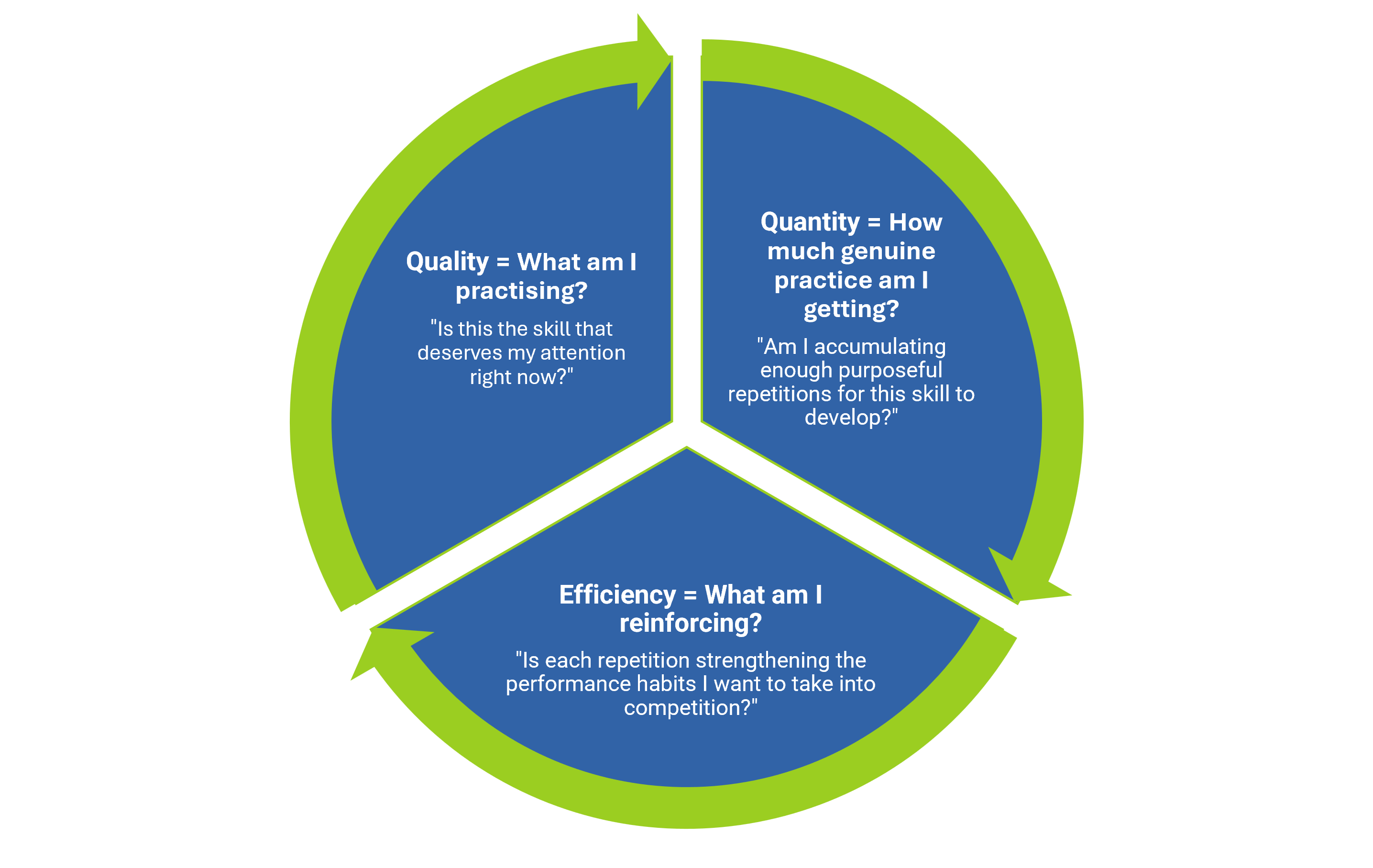
Looking back, each of these three elements has a different role:
- Quality determines what you practice.
- Quantity determines how much you practice it.
- Efficiency determines what every repetition teaches you.
I like to think about these three elements like a multiplication equation:
Progress ≈ Quality × Quantity × Efficiency
Not as a mathematical formula, but as a reminder that all three elements matter. If one factor is very low, the benefit of the others is reduced. In other words, each part affects the next.
High quality × high quantity × poor efficiency can create many technically correct repetitions, mixed with frustration, distraction, and negative learning.
Excellent efficiency × poor quality can mean you are becoming very good at doing the wrong thing.
The goal is not simply to train more. The goal is to create training that produces improvement.
More Recent Pointers
Why choosing the right water bottle is important for your health.
Training, pressure, and mindset – Goran and Tea Mikec on what really builds performance in air pistol shooting.
Make every practice count by writing your personal shooting analysis. Monitor your progress and see yourself improve!
Be among the first to receive our Practical Pointers and best offers,
a few times per month!