Shooting Pointers, Psychological Pointers, Tactical Pointers

Roots of Performance Pressure: Fear of Social Judgement – Part 3

Živa Dvoršak

Apr 3, 2026

Success and failure both invite evaluation. A miss can bring criticism, disappointment, or doubt. A strong performance can attract attention, raise expectations, and invite comparison. In both cases, the shooter may begin to sense that the shot is no longer private.

What was previously experienced internally – fear of failure or fear of success – now gains an external dimension. The shooter is no longer only responding to losing or gaining something, but also to how the performance might be seen, judged, or discussed by others. The nervous system shifts attention from executing the shot to thinking about what it might mean, even when no one is actively watching.

This is where fear of social judgment begins to shape performance.

A group of students dressed in red loudly cheering for their sports team

Fear of Social Judgement

Fear of social judgment arises when performance is no longer experienced as personal but as something that may be evaluated by others. In these moments, the nervous system is not responding only to the shot itself, but to what that shot might mean in the eyes of others.

Attention begins to move outward. Instead of sensing the body, rhythm, and timing of the shot, the shooter starts monitoring themselves through imagined eyes, often becoming hesitant or overcontrolling. The shot is no longer simply executed – it is observed, anticipated, and mentally managed, gradually disrupting flow and consistency.

When Performance and Identity Collapse

Underneath concerns about judgment often sits a quieter fear:

What does this performance say about who I am?

Without realising it, the shooter may start protecting not just a score or a position, but an emerging identity – the one who is expected to perform, the one who is becoming a serious competitor, or the one who suddenly feels they have something to prove.

When this happens, the cost of each shot increases. A miss can feel personal, while a good shot begins to feel like something that must be preserved. The nervous system responds by trying to manage the outcome or the impression it creates, rather than allowing the trained process to unfold.

The challenge is not that shooters care about judgment, but that execution and self-image gradually collapse into one. At that point, attention drifts away from the task and into protection mode.

From Social Judgment to Owning the Shot

While this entanglement between performance and self-image can feel daunting – and even damaging at times – there is good news: the very mechanisms that create this pressure can also be harnessed to strengthen our mental game.

As Lanny Bassham describes in With Winning in Mind, our self-image is shaped not only by real outcomes but also by what we repeatedly experience or mentally rehearse. The mind does not clearly distinguish between what actually happens and what is vividly imagined – nor do they always separate past, present, and future experiences. This means that every mental rehearsal, memory, or even anticipation can shape our self-image just as powerfully as actual events.

For this reason, he suggests briefly rehearsing the feeling of a successful shot immediately before and immediately after execution. Rather than visualising the entire shot, the focus is on recalling the physical sensation of a well-executed hit – the rhythm, stability, and quiet moment of confirmation.

Each real or mentally rehearsed success becomes an imprint that gradually strengthens the shooter’s self-image as someone capable of executing well under pressure.

With this in mind, we can deliberately train how we respond to the presence of others. The following training situations expose shooters, in a controlled way, to moments where performance feels visible or meaningful to others. Instead of eliminating social pressure, we practice staying connected to the process even when evaluation appears and identity begins to feel at stake.

A group of young people booing, provoking the fear of social judgement

Drill 1: Training with an Audience

Arrange for teammates, friends, or family members to stand behind the firing line during training. Their role is to create a sense of being watched and heard. They can bring small noisemakers such as rattles, clappers, or simply loudly cheer, clap, and verbally react.

You can vary the exercise by agreeing on different “modes” beforehand. For part of the training, the group can actively cheer and encourage good shots. At other times, they can react negatively to weaker shots – booing, commenting, or playfully criticising (“Come on, you can do better” or similar remarks). Structuring the reactions this way – instead of cheering randomly – also connects the training ideas from Part 1 and Part 2 of the Roots of Performance Pressure .

The goal of the drill is not to shoot perfectly despite the reactions, but to notice how attention shifts when performance feels visible and evaluated – whether through criticism, expectation, or encouragement. Each shot becomes an opportunity to return attention from the audience back to physical cues and execution.

Drill 2: Calling the Shot

Before each shot, clearly announce the expected result out loud – for example, the score or the intended shot quality. Writing the prediction down can also be used as an alternative, but saying it aloud usually increases the sense of commitment.

This creates a small moment of public evaluation: the outcome of the shot will immediately confirm or challenge what was announced. Many shooters notice an increased urge to control the shot or to avoid being wrong.

Again, the task is not to prove the prediction correct, but to execute the shot with the same routine and physical focus regardless of the outcome, and even if it feels publicly visible.

Drill 3: Finals Environment Training

During training, play a YouTube recording of an ISSF final and shoot alongside it. Instead of using the video only as background sound, actively join the rhythm of the final. Listen to the commentator, the crowd reactions, and the timing of the commands. Shoot your shots at the same tempo, while also experiencing the time pressure of a final, including the shortened preparation time between shots and the heightened intensity of the environment.

This exercise recreates the atmosphere of visibility and evaluation present in competition finals while also training timing, rhythm, and decision-making under pressure. The goal is to experience the presence of an audience and commentary while continuing to execute the same process used in normal training.

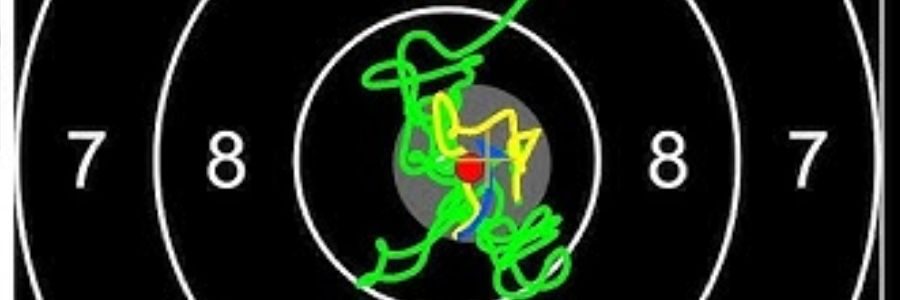
A close up of the Scatt trace

All three drills deliberately introduce something many shooters tend to avoid in training: being observed. If the presence of others already creates tension during practice – even among teammates or friends – it becomes even more important to expose ourselves to such situations deliberately. Training then becomes the place where shooters gradually become familiar with this discomfort instead of encountering it for the first time in competition.

By repeating these scenarios, shooters begin to notice when attention drifts outward and focus becomes harder to maintain. The task is simply to recognise these moments and return attention to the process. Over time, the presence of observers becomes less disruptive. When similar situations appear in competition, shooters can mentally return to the feeling of training – almost as if they were again standing on their home range.

For an even stronger training effect, drills can be amplified by adding visible feedback performance tools: SCATT, heart-rate monitors, or other tracking tools can be set up so that observers also see how the shooter’s internal state response during execution. This adds another layer of social exposure: not only is the performance visible, but the body’s reactions are as well. Training with this level of visibility helps shooters gradually become more comfortable performing even when everything feels “on display”.

Failure, success, and evaluation are always part of shooting – a shot can go wrong, a series can excel, and spectators may watch or form judgments. These are realities we cannot fully control.

At Aiming Art, we focus on what we can influence. We step onto the line with intention, follow our routine, and stay connected to the physical and mental cues of each shot. By anchoring attention in the process rather than the outcome, tension eases, performance stabilises, and trust in our skills grows.

Practical tools, like Shooting Notes, make this approach tangible. Writing reflections, plans, and observations by hand shooters engage both mind and body – reinforcing decisions, physical cues, and execution instead of focusing solely on outcomes. This act of physically recording performance helps imprint the experience, shaping self-image and building confidence in the process. Over time, this cultivates trust: trust that the body knows what to do, trust that success does not need to be forced, and trust that every shot is simply another opportunity to execute.

Share this post

Leave a Comment

Your email address will not be published. Required fields are marked *

More Recent Pointers

Fear of social judgment and performance pressure in shooting – and how training exposure helps shooters stay with their process when others are watching.

Fear of success and performance pressure in shooting – and how training exposure helps shooters keep executing when things go well.

Fear of failure and performance pressure in shooting – and how training exposure helps shooters stay with their process.

Aiming art mobile view background on the bottom of the page
Aiming art background on the side of the web page on the bottom
Cover of the slovenian strelski zvezek notebook on an opened notebook

Make every practice count by writing your personal shooting analysis. Monitor your progress and see yourself improve!

Aiming art background on the side of the web page on the bottom

Be among the first to receive our Practical Pointers and best offers,
a few times per month!

Shopping Cart